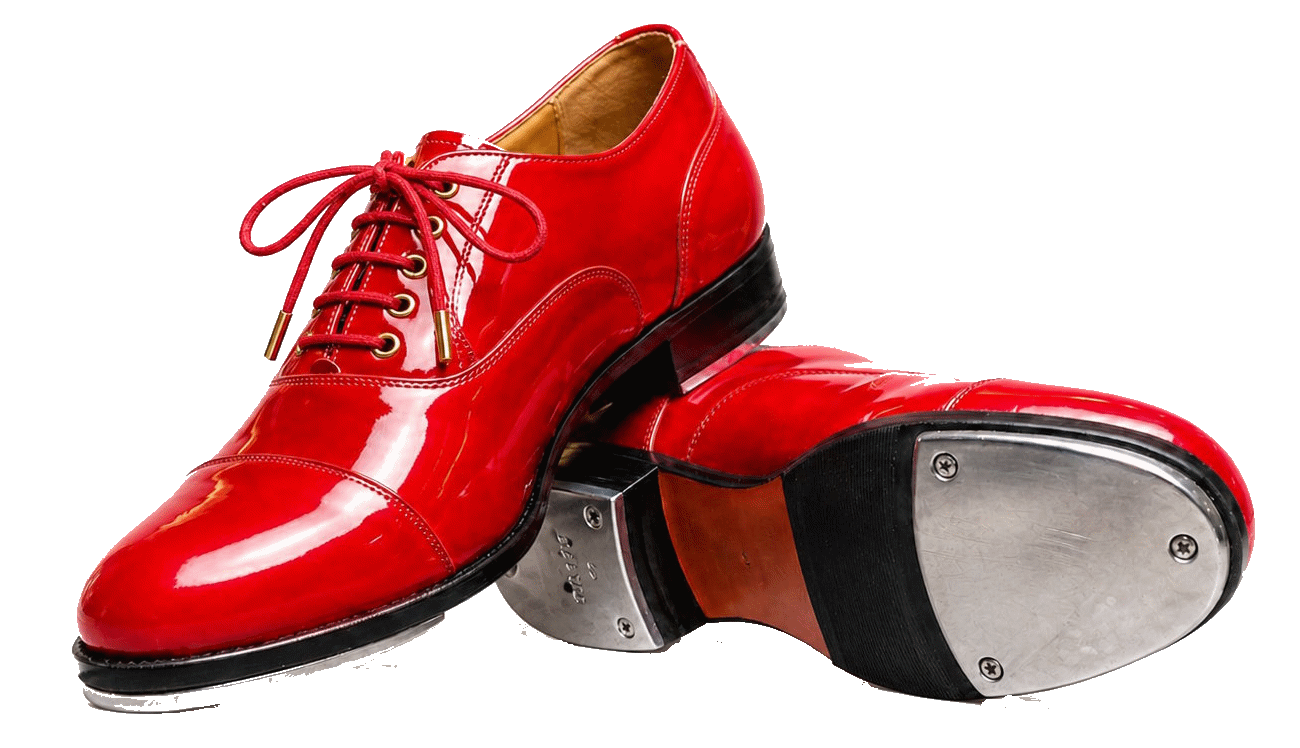
Echoes ↓
While The Red Tap Shoes explores many themes and motifs, the central theme is the struggle between fate and personal agency.
Identity and Self-Image:
The musical explores the theme of self-identity and self-image through Sam's internal struggles. He grapples with his perception of himself as a poor homeless man and his desire for validation and success. This theme raises questions about the impact of societal expectations and self-perception on one's choices and sense of self-worth. Throughout the musical, Sam struggles with his sense of identity and belonging. His many coats serve as a physical manifestation of his attempts to find a place where he feels he belongs. Ultimately, Sam learns that his identity is not defined by material possessions or societal expectations, but by his own sense of self and his passions.
The Transformative Power of Art:
The musical highlights the transformative power of art, particularly dance, as a means of self-expression and a way to find hope and joy in difficult circumstances. This is exemplified by Sam's passion for tap dancing and the magical red tap shoes, which allow him to tap into his creative potential and overcome his hardships.
The Power of Music and Dance:
Music and dance hold a significant place in the show, symbolizing freedom, expression, and the ability to transcend one's circumstances. The red tap shoes themselves become a symbol of the transformative power of art and creativity.
Religion and Spirituality:
The presence of Sister Sarah Jane and Tyrese introduces religious and spiritual themes. Sister Sarah Jane represents faith and the belief in divine guidance, while Tyrese embodies superstition and mysticism. These contrasting perspectives explore the role of faith, the search for meaning, and the influence of supernatural beliefs on the characters' actions and decisions.
Redemption and Self-Reflection:
The concept of redemption is explored through Sam's journey, as he confronts the consequences of his actions and seeks to find a sense of peace and acceptance. It highlights the capacity for personal growth, self-reflection, and the pursuit of forgiveness.
The Illusion of Success:
The show examines the pursuit of fame, power, and success, questioning the true value and fulfillment they bring. The red tap shoes serve as a metaphor for the illusion of success and the dangers of sacrificing one's values and integrity in the pursuit of external validation. This theme challenges societal notions of success and encourages introspection about personal definitions of fulfillment.
The Sacred vs. The Secular:
The setting itself -- an alley between a church and a speakeasy -- establishes this core conflict. Sister Sarah Jane represents the sacred: community, humility, and spiritual salvation. Peter Wheatstraw represents the secular stage: individual ambition, worldly success, and moral compromise. Sam is perpetually caught between these two worlds, and his tragedy unfolds as he repeatedly chooses the promises of the speakeasy over the warnings of the church until he has nothing left but to seek spiritual intervention.
The Faustian Bargain & The Price of Fame:
This is the central theme of the musical. Sam knowingly trades his autonomy for a pair of magical shoes that grant him the talent and success he craves. The narrative tracks the escalating cost of this deal, from losing personal relationships (Desiree, Sarah Jane) to sacrificing his physical and spiritual well-being. The ever-tightening contracts and the shoes themselves are powerful motifs representing the seductive but ultimately destructive nature of ambition untethered from one's soul.
Freedom vs. Bondage:
The story presents a layered exploration of freedom. Sam, initially free but impoverished, willingly enters a state of contractual bondage for fame. His struggle is not just against Wheatstraw, but against the shoes themselves, which force him to dance against his will. This physical and artistic enslavement is contrasted with the spiritual freedom offered by Sister Sarah Jane and the legend of the Flying Africans, which ultimately provides Sam's only true path to liberation -- one that requires transcending the physical world entirely.
Apollonian v Dionysian:
Friedrich Nietzsche in his book The Birth of Tragedy, contrasted the Apollonian -- which he associated with sculpture and music as embodying the principles of order, form, and beauty -- with the Dionysian -- associating it with dance and theater as embodying the principles of chaos, frenzy, and ecstasy.
Liminality
W.E.B. Du Bois famously defined "twoness" in The Souls of Black Folk (1903):
“It is a peculiar sensation, this double-consciousness, this sense of always looking at one's self through the eyes of others, of measuring one's soul by the tape of a world that looks on in amused contempt and pity”.
This "two-ess" is the heartbeat of the greatest African American literature and music. The Red Tap Shoes is an exploration of the "double consciousness" W.E.B. Du Bois wrote about, rendered as a jazz-age fever dream.
The Red Tap Shoes is analogous to Trickster fables in character and theme, and in a tradition specific to African American trickster tales, both are intended to teach moral lessons. They educate by exploring the protagonist's dual nature and by exposing the social and personal consequences of duplicity.
The Trickster character itself is a living paradox of impossible opposites. Both hapless and happy-go-lucky, the Trickster is a hero and a clown. Trickster tales tend to be tragicomedies, and in many cases, these fables serve as contemplations of the connection between the sacred and the profane. It's not surprising that writers who are at once, both African and American would connect their stories to the sometimes convenient -- sometimes confounding, dual nature of the trickster. African-American fables tend to emphasize the trickster's liminality -- that is to say, the trickster's ambiguous existence at the exact threshold between two, completely separate worlds.
Significantly, in the African-American oral tradition, the Trickster tale is a hybrid, a funny folk fantasy and an edifying parable alluding to actual people or events.
Crossroads:
The recurring motif of crossroads represents pivotal moments of decision and the paths characters choose to take. The crossroads symbolize the choices we face in life and the consequences that arise from those choices. It underscores the idea that our decisions shape our destinies, highlighting the importance of thoughtful reflection and self-awareness.
Thunder, Rain & Storms:
The metaphorical use of storms and rain reflects the turbulent events that befall Sam and the larger universal forces at work. Storms symbolize challenges, hardships, and the uncontrollable aspects of life. This motif explores resilience, finding strength in adversity, and the transformative power of embracing life's difficulties.
Overcoat:
coat as burden
coat as aspiration
coat as disguise
coat as status
coat as homelessness
coat as theatrical costume
coat as ritual vestment
coat as burial material
coat as resurrection garment
Inheritances ↓
The melting plot of myths, legends, fables, and folklore in The Red Tap Shoes can speak to the fluid and ever-evolving nature of stories themselves. Over time, stories transform and adapt, taking on new meanings and interpretations as they are retold and reimagined in different contexts. This burlesque, with its mosaic of narratives, demonstrates how stories are not fixed items but living entities that continue to resonate and evolve.
In embracing this eclectic remix of storytelling traditions, audiences are invited to explore the deeper layers of meaning and connections that exist within these narratives. The aim is to encourage audiences to reflect on the universality of human experiences and the enduring power of storytelling as a means of expression, understanding, and connection.
The Red Shoes
(Hans Christian Andersen)
Andersen's literary fairy tale, first published in Copenhagen on April 7, 1845, follows a young girl whose vanity leads her to a pair of enchanted red shoes that force her to dance uncontrollably.
The Danish poet and author named the story's anti-heroine, "Karen," after his own loathed half-sister, Karen Marie Andersen. It is ostensibly a parable about succumbing to desire -- reflected in the story of Andersen's mother's "illegitimate" child, Karen Marie. Raised by her maternal grandmother, she haunted Andersen as "an emblem of degradation, ignorance and poverty," the product of sin who herself may have become a prostitute.
The origin of the story is based on an incident Andersen witnessed as a small child. His father, who was a shoemaker, was sent a piece of red silk by a wealthy woman to make a pair of dancing slippers for her own daughter. When presented with the shoes, the customer rejected them, saying he had "done nothing but spoil her silk." Andersen's father replied, "In that case, I may as well spoil my leather too," and he cut up the shoes in front of her.
Andersen was a man of "deep and apparently irreconcilable contrasts" whose writings are profoundly concerned with dualism.
Although Andersen is often credited as the first author to make use of red-colored shoes as a literary device, Jakob and Wilhelm Grimm had used the concept in a slightly different manner in "Snow White." Jungian psychologist, Clarissa Pinkola Estes unearthed a Magyar-Germanic version of an old woman's tale known as "The Red Hot Shoes of the Devil" or "The Red Shoes," asserting that Andersen's version is a retelling of a much older story.
The Red Shoes (1948 Film)
The classic Powell and Pressburger film explores the "art vs. life" conflict through a ballerina torn between her love for a composer and her devotion to a demanding impresario. Its lush, surreal visual language inspired a free exploration of staging possibilities.
The Oedipus Myth
One of the foundational tragedies of Western literature, this myth centers on a man who inadvertently fulfills a terrifying prophecy despite his desperate efforts to avoid it. This source explores the themes of fate, free will, and the devastating price of uncovering a hidden truth.
The Faust Myth
This legendary tale of a scholar who barters his soul for infinite knowledge and worldly pleasure captures the quintessential human desire for transcendence. It provided the framework for a character who is willing to risk everything for a "moment of greatness".
Legend of Theophilus
Theophilus was a cleric in the 6th century who, according to the legend, made a pact with the devil in order to regain his position and power within the church. This story, known as "Theophilus of Adana," has its origins in Eastern Christianity. The legend tells of Theophilus, who was originally a respected cleric but was unjustly removed from his position. Feeling desperate, he made a pact with the devil, signing a contract with his own blood to gain back his position and influence. The devil fulfilled his part of the bargain, but Theophilus soon regretted his decision and sought forgiveness from the Virgin Mary. Through her intercession, his contract with the devil was nullified, and he was able to redeem himself.
The Legend of the Flying Africans
Rooted in Gullah folklore, this powerful legend tells of enslaved people who escaped their captors by taking flight back to Africa. It serves as a spiritual counterbalance in the show, representing the ultimate desire for liberation and the reclamation of one's own body and spirit.
The Robert Johnson Mythos
The legend of the Delta bluesman who supposedly sold his soul to the devil at a Mississippi crossroads to master the guitar. This folklore helps ground the supernatural elements of the musical in a specific, gritty musical tradition of sacrifice for artistic genius.
Petrushka
Stravinsky’s vibrant ballet tells the story of a puppet with a human soul, trapped in a tragic love triangle and a cycle of performance. Its themes of agency and the "performer's mask" influenced the approach to characters who feel like puppets of their own ambitions.
Giselle
In the classic ballet Giselle, the "Wilis" (spirits of jilted brides) force men to dance until they die of exhaustion. In some versions, the spell is broken only when the queen's magic wand literally breaks. This show's text mirrors that ancient, supernatural exhaustion, where the rhythm is no longer a choice, but rather, a fatal command that continues until the music itself shatters.
The Poetry of Paul Laurence Dunbar
As a pioneer of the African American literary tradition, Dunbar’s work, which navigates the tension between formal verse and folk dialect, is essential to the linguistic texture of the libretto. His exploration of the "mask" that hides the soul’s true feelings provides a profound emotional layer to the characters’ public performances and private struggles.
The Waste Land (T.S. Eliot)
This landmark modernist poem provided the atmospheric and structural inspiration for the setting, with its fragmented imagery of a world searching for spiritual rebirth. Its exploration of memory, desire, and cultural decay helped build the world our characters inhabit.
The Waste Land is renowned for its extensive use of references to various mythologies, literary works, historical events, and cultural symbols. The poem itself is a complex collage of fragments and allusions that weave together different voices and perspectives, reflecting the fragmented and disillusioned state of post-World War I society.
Eliot's deliberate inclusion of diverse references serves multiple purposes. First, it creates a sense of intertextuality, drawing upon the collective cultural and literary heritage to enrich the poem's meaning. The references range from ancient myths and religious texts to Shakespearean plays, classical literature, and modern works. These allusions create a multilayered texture, inviting readers to engage with the poem on multiple levels and rewarding those who recognize and decipher the references.
Second, the use of references in The Waste Land helps convey the poem's theme of disillusionment and spiritual decay. By juxtaposing fragments of cultural and historical moments, Eliot suggests a fragmented and disintegrated society that has lost its sense of unity and purpose. The references serve as fragments of meaning, illustrating the shattered state of the modern world and the difficulties of finding coherence and meaning within it.
Furthermore, the extensive use of references in The Waste Land can be seen as a commentary on the nature of art and literature itself. Eliot believed that art should not exist in isolation but should be in constant dialogue with the past, drawing from and responding to earlier works. By incorporating references to a wide range of sources, Eliot highlights the intertextual nature of literature, showing how new creations emerge from a web of influences and connections.
Grace Notes ↓
Foundational Black Music Genres
SPIRITUALS and RAGTIME
Enslaved Africans created Spirituals by blending ancestral rhythms with traditional hymns. By the late 1800s, geniuses like Scott Joplin developed Ragtime, a syncopated, piano-driven style that set the stage for modern syncopation.
BLUES, GOSPEL and JAZZ
In the early 1900s, the Blues emerged from the Deep South, introducing raw emotional storytelling and the 12-bar progression. Urban churches simultaneously birthed Gospel, fusing spiritual roots with passionate, joyful vocals. Soon after, New Orleans musicians blended these styles into Jazz, a revolutionary art form built entirely on improvisation and swing.
R&B, ROCK and SOUL
By the 1940s, Rhythm and Blues electrified the scene with heavy, driving beats. This directly birthed Rock and Roll, pioneered by Black icons like Chuck Berry and Sister Rosetta Tharpe who changed global youth culture forever. By the 1960s, Soul took over, combining gospel passion with secular romance.
Iron City
The historical context of Pittsburgh as a thriving center of jazz and performing arts, particularly within the African American community, provides a rich backdrop for Overcoat Sam's experiences and journey. The association with notable artists and musicians from Pittsburgh adds depth to the musical's connection to the cultural heritage and artistic legacy of the city.
The reference to Pittsburgh as "The Crossroads of the World" aligns with Sam's own position at a metaphorical crossroad in his life and reinforces the idea of the back alley as a symbolic space of choices and transformation.
The portrayal of Pittsburgh as a smoky, gritty, and tough city contributes to the atmospheric and immersive qualities of the setting, enhancing the overall mood and tone of the musical. The parallel between the three powerful wives of Shango and the three rivers of Pittsburgh adds a layer of symbolism and mythology to the narrative, tying together cultural elements and further exploring themes of spirituality and transformation.
Burlesque
Burlesque has worn many costumes across the centuries -- some glittering, some ragged, all a little mischievous.
In its older, European sense, burlesque is not about undressing the body so much as undressing ideas. The word comes from the Italian burla -- a joke, a trick, a playful deception. In this tradition, burlesque is a theatrical art of exaggeration and inversion: it takes something grand and treats it as low, or something ordinary and inflates it to absurd importance. Kings speak like clowns, beggars speak like philosophers, and the “serious” world is turned on its head just long enough for us to see it clearly.
Writers like Molière and Alexander Pope used burlesque to parody classical forms, mock social pretensions, and slip sharp truths into elegant comedy. Myth, religion, literature, and polite society -- all could be reimagined, distorted, and joyfully “sent up” in order to reveal their hidden contradictions. The tone might be playful, even ridiculous, but the aim is often serious: to question power, expose hypocrisy, and wrestle with big ideas -- fate, morality, ambition -- through laughter and theatricality.
On stage, burlesque thrives on bold performance. It invites direct address, heightened language, musicality, and a knowing wink to the audience. It is not bound by strict realism; instead, it delights in artifice -- announcing itself as performance, blurring the line between narrator and character, story and spectacle. It can move quickly, sketching scenes rather than dwelling in them, because its energy lies in rhythm, surprise, and transformation.
In the context of a musical like The Red Tap Shoes, “burlesque” suggests a style where music, dance, and storytelling collide with satire and myth. Characters may step outside the action to comment on it, songs may carry both humor and prophecy, and the world itself may feel heightened -- half alleyway, half dream. Comedy and tragedy are not opposites here; they dance together, trading steps. A joke can land like a warning, and a spectacle can carry the weight of destiny. In short, burlesque is theater with a sly grin and a sharp mind: a form that entertains boldly while quietly asking, “What if everything you took seriously… is part of the joke?”
The Rhythm of the Shine:
A Legendary American Tradition
The character, Shine Bo Banjo, represents a rich, high-art street tradition known as rhythmic shoe shining -- a beautiful piece of Black history that turned a daily chore into a master class in percussion and performance. Rooted deeply in the American South, this tradition wasn't just about a clean polish. It was about showmanship, music, and rhythm. Master shiners used a specific toolkit to turn their work into a song:
The Rag Pop: They would snap, snap, and crack the polishing cloth across the leather to mimic a sharp snare drum.
The Brush Clack: They would rhythmically tap the wooden backs of their brushes against the side of the shoeshine box.
The Step: Many shiners would execute tap footwork while leaning over the customer's foot, blending work with dance.
This culture was so vibrant that it led to massive, organized competitions. The most famous was the Annual Shoe Shining Contest in Wilson, North Carolina, which began in the mid-20th century. These events drew crowds of up to 12,000 visitors a year. Judges didn't just grade the final gloss of the leather - they awarded points for the entertainment, the singing, and the rhythm of the performance.
This rhythmic heritage is a fundamental pillar of Black American performance history - where everyday labor was elevated into an unforgettable art form. James Brown ("The Godfather of Soul") famously got his start as a boy singing, dancing, and popping rags at a shoeshine stand in Georgia.
Shake Dancers
Long before the word “stripper” became common shorthand, the stars of the Black jazz-age burlesque circuit -- performers like pioneering entertainers Bessie Dudley and Madeline 'Sahji' Jackson -- were known as shake dancers.
In the neon nightlife of the Hill District of Pittsburgh and other urban entertainment centers, these dancers blended the glamour of the chorus line with rhythmic, improvisational movement deeply rooted in African American performance traditions.
Shingle Dancers
Shingle dancing is a form of solo dancing akin to tap dancing, of African American origin, usually associated with old-time music. A shingle dancer dances on a small wooden platform (typically no more than about 30 inches square), sometimes equipped with a bell or a loose piece of metal to allow additional percussive effects.
Tap Dance History
The 1739 slave insurrection in Stono, Va. -- triggered when African slaves drum-beat a message of revolt to alert slaves at neighboring plantations -- led to passage of the 1740 Slave Act, forbidding slaves from beating drums, blowing horns or the like. To substitute for musical instruments, hand claps and foot beats were used, creating a music form where dancers made their own rhythms and sounds.
These new rhythms were subsequently applied derisively to European dances on plantations, frequently for the amusement of white owners. For example, the Cakewalk, where a cake prize was given to the slave who performed the fanciest walk before a white audience, was a parody of the minuet grand march at whites fancy parties. Slaves also copied techniques of Irish jig dancers visiting the plantations.
In Louisville, Ky., in 1828, a white dancer calling himself "Jumping Jim Crow" did a parody-in-blackface of this new slave dancing. The minstrel show was born; whites parodied blacks parodying whites. In 1844, a free-born black dancer, Juba, King of All Dancers, fused European steps with African rhythms before white audiences in public competitions with an Irish jig dancer; he was the major black minstrel-era dancer in America and Europe.
Buck dancing was the earliest combination of basic shuffle and tap steps, performed to syncopated rhythms, in which the accent is placed on the down or off beat--a style derived from African tribal music. There were two distinct dance techniques by late 19th century, buck-and-wing and soft-shoe. The former was active, fast and danced in wooden or hard leather-soled shoes. Soft-shoe was relaxed and smooth. It developed from dances like the German-Irish waltz clog, fusing German immigrant folk dancing with Irish jigs, and from slow-tempoed shuffles like the Essence of Old Virginia.
Synchronized tap dancing was introduced by the Floradora Girls in 1900, and the term tap and step dancing was introduced in a 1902 minstrel show. Metal cleats were now worn on heels and toes of leather shoes. As vaudeville supplanted minstrel shows, tap dancing developed with great vigor in two different paths, one white and one black. One led from George M. Cohan to Fred Astaire. The other produced the great Bill Robinson, known as "Bojangles."
Tap dance did not develop in linear progression from a single ethnic source; it is a uniquely American creation resulting from a blending of cultures, of Old World traditions and New World imagination, and drew equally from Europeans and Africans to make a new dance form.
Time Steps
Tap dance as it is known today did not emerge until roughly the 1920s, when "taps," nailed or screwed onto shoe soles at the toes and heels, became popular. During this time entire chorus lines in shows such as Shuffle Along (1921) first appeared on stage with "tap shoes," and the dance they did became known as tap dancing.
The "challenge" in which tap dancers challenged one another to a dancing "duel" -- had been a major part of the tap dancer's education from the beginning. It filtered into many theatrical acts.
From the outset, tap dancers have stretched the art form, dancing to a wide variety of music and improvising new styles. Among these innovative styles were flash (dance movements that incorporated acrobatics and were often used to finish a dance); novelty (the incorporation into a routine of specialty props, such as jump ropes, suitcases, and stairs); eccentric, legomania, and comedy (each of which used the body in eccentric and comic ways to fool the eye and characteristically involved wild and wiggly leg movements); swing tap, also known as classical tap (combining the upper body movement found in 20th-century ballet and jazz with percussive, syncopated footwork, a style used extensively in the movies); class (precision dancing performed by impeccably dressed dancers); military (the use of military marching and drum rhythms); and rhythm, close floor, and paddle and roll (each of which emphasized footwork using heel and toe taps, typically of a rapid and rhythmic nature).
Tap gained popularity after the Civil War as a part of traveling minstrel shows. There were two distinct dance techniques by late 19th century, buck-and-wing and soft-shoe. It was not until the period between 1900 and 1920 that tap dance emerged as a dance form in its own right. With it, tap dance shoes were born. In the earliest days of tap dance, pennies or hobnails were hammered into the toe and heels of shoes, to create the tap sound as performers danced. Before 1910, tap dancers wore shoes made with leather uppers and wooden soles, so that the wood tapped out the beat. After 1910, it became the fashion to apply metal taps to the bottoms of tap dance shoes.
The popularity of tap dancing began to decline in the 1950s.
This change is often attributed to a series of events in the 1940s. In 1942 Agnes de Mille introduced narrative ballet into the Broadway show with Oklahoma. Although in Rodeo (1942) she had also been the first to introduce tap dance into ballet, her billing as a "choreographer" and the false competition with ballet made tap seem "hokey" and passe. Another factor in the waning of tap dance was a dramatic drop in nightclub attendance, as men and women who had come home from service overseas concentrated on getting an education, starting careers, and raising families.
Bill "Bojangles" Robinson
Bill Robinson was an iconic American tap dancer and actor who revolutionized dance by moving it from a flat-footed style to a light, rhythmic toe-and-heel technique. While it is not known exactly where the name "Bojangles," came from, some contend it is a contraction for "bone jangler" or a musician who beats time by clapping together a pair of bones or simply a drummer. Robinson began his career in minstrel shows and vaudeville, eventually breaking racial barriers as a headliner on Broadway and a star in major Hollywood films, famously starring alongside Shirley Temple in the 1930s.
Despite being the highest-paid Black performer of the first half of the 20th century and earning over $2 million in his lifetime, Bill Robinson died penniless on November 25, 1949.
Robinson's immense wealth was completely depleted by legendary generosity to charities, support for struggling artists, and personal gambling losses. Though he died without funds -- forcing friends to pay for his burial -- nearly 100,000 people lined the streets of New York for his funeral to honor his massive cultural legacy.
Swellfoot
It is significant that the swollen feet, and the dark events of being abandoned, become Oedipus -- and become what drives him to seek the light of knowledge. The sphinx riddle alludes to this paradox in the riddle about walking -- it is a riddle about feet. Oedipus is driven by his darkness and becomes obsessed with light. Metaphorically, it is actually this obsession with seeing the light and knowing all the answers that blinds Oedipus to the fact that, as a mortal man, there are simply some things we do not know and cannot understand. As humans, we are "in the dark."
In that same sense, it is actually Overcoat Sam's dark despair and anger at being a poor, homeless hobo, forced to dance on the street for pennies, that drives him to desire the red tap shoes – and all that they represent to him. Overcoat Sam got his name because, since he felt alone and vulnerable in a dark cold world, he began protecting himself under layers of coats, trying to hide from the darkness he felt. Like Oedipus Swell Foot, Overcoat Sam becomes his name, he becomes the darkness he feels. It is this perception of darkness that leads Overcoat Sam to become obsessed with seeking light -- here light may imply both the light of knowledge of tap dancing skills and the shining stage light of fame, fortune and adulation.
But Sam's obsession with light, becomes a blind spot since Sam fails to carefully consider the consequences of fame and showing off and being in the spotlight. Sam is so obsessed with seeking light that he sheds all of his overcoats and metaphorically exposes all of his inner-self to the heat and glare of light, not considering that some things are meant to stay private or hidden in a back alley.
The Faust legend also reverberates with these themes. Oedipus' swollen feet form his identity and his tyrannical insistence on seeking knowledge -- the knowledge of the kind's murderer. Like Faust, Oedipus seeks knowledge even when warned that such knowledge could prove deadly. Like Faust, Overcoat Sam seeks the knowledge of great tap dancing, and desires to know the experience of romantic love, fame and public adoration. And of course, it is ultimately these things that Sam so desires, that bring his downfall -- and result in Sam chopping off his own feet.
Dance and Desire
Two principle sources for the play include the fable of "The Red Shoes" and the legend of "Faust."
Red Shoes' protagonist, Katrina, while rich in spirit, is very poor. On the other hand, Dr. Faust is wealthy but wretched. Riches to Rags or vice versa -- money is at the root. The point seems to be: You don't know what you've got till it's gone."
Satan is certainly the villain in these pieces, but in all "making a deal with the devil" stories, tragedy comes as a consequence of the protagonist's actions. Both Katrina and Faust are undone by their own selfish single-mindedness -- and like Eve accepting the Serpent's offer of fruit from the "Tree of Knowledge" -- both protagonists turn a blind eye to repeated warnings and red flags, removing disruptions to the dark contemplation of their temptation.
True, Satan tempted Eve, but Eve wanted the apple – Satan only tempted Eve to do what she had already decided she would do.
Yes, the powerful, magical beauty of the Red Shoes tempted Katrina, but it is Katrina who felt she lacked something, was missing something, deserved something or needed something to get the attention of other people. Upon first seeing the Red Shoes, Katrina begins manipulating her stepmother into buying them, immediately deciding she had to have the shoes. Not because the shoes fit her feet, but because they perfectly fit the size and contours of her need to be seen, acknowledged and loved. The Red Shoes merely tempt Katrina to do a dance she’d already practiced in her mind.
The determined Dr. Frankenstein is similarly warned about his experiments, but even as the inevitable horrors begin for the society at large, the Faustian hero continues to justify the trade-off and pursues his/her personal dream.
"Jabez Stone," hero of Stephen Vincent Benét’s short story "The Devil and Daniel Webster," actually manages to prove he had valid reasons to bargain with the devil, by winning a trial by jury. The Prince of Darkness caught in a court of law is less than satisfactory, however, Benét’s alternate ending further illustrates the Faustian protagonist's dual identity as both hero -- and villain.
Katrina's red shoes and Dorothy's ruby slippers from the Land of Oz, are shiny fruit from the Tree of Knowledge. Caving in to temptation requires a physical representation of a spiritual doorway. For Little Red Riding-hood -- it's the cute, red cape -- and one suspects that, regardless of the path Little Red took, the Wolf would've spotted her. Warnings to Red about the colorful encounters possible along a short-cut to Grandmother's house only served to map out her adventure.
All of Cinderella's riches returned to rags at midnight -- except her delicate glass slippers. They survived to tell the tale. Cinderella's slippers are as substantially real as they are fantastically magic. They are the exact puncture point in the fabric of space and time between two worlds. An artifact of the stroke of midnight, the magic shoes exist in every yesterday and every tomorrow. They will never, ever disappear. They cannot be destroyed and further, Cinderella's shoes fit only her. The magic item is non-transferable.
Significantly, the magic item delights as much as it torments, and as the channel of the adventure, it takes on the significance of a central character. The story of Red Tap Shoes then, is the struggle between those who say, "curiosity killed the cat" and those who figure, "nothing ventured -- nothing gained."